
Ever laughed at a clever play on words and wondered why it was funny? That’s the magic of a pun. If you’ve been asking what is a pun, you’re not alone — it’s one of the most common literary devices used in humor, advertising, and everyday conversation. Simply put, a pun is a form of wordplay that uses multiple meanings or similar-sounding words to create humor or emphasis.
This guide breaks down the concept in plain language, shows real examples, and explains how puns work in literature and daily speech.
What Is a Pun? Simple Definition
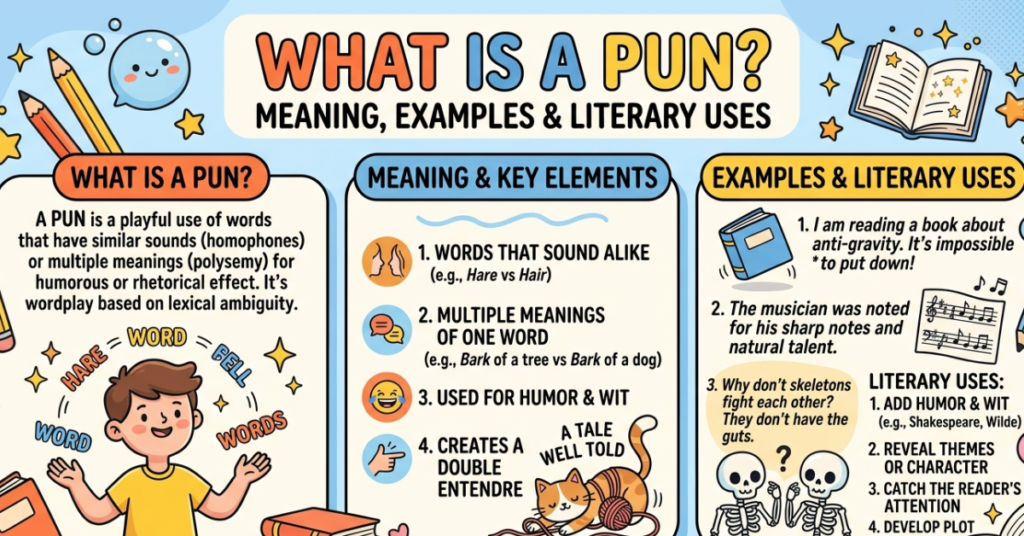
A pun is a joke or expression that plays on the different meanings of a word, or on words that sound alike but have different meanings.
Example:
- I used to be a baker, but I couldn’t make enough dough.
Here, “dough” refers to both bread mixture and money — that double meaning creates humor.
Puns are popular because they’re short, clever, and easy to remember. You’ll find them everywhere — from memes to Shakespeare.
What Is a Pun in Literature?
In literature, writers use puns to add humor, create irony, or emphasize themes. This technique has been around for centuries and appears in poetry, plays, and novels.
Famous Literary Example
William Shakespeare loved wordplay. In Romeo and Juliet, Mercutio says:
“Ask for me tomorrow, and you shall find me a grave man.”
The word grave means both serious and a burial place. The double meaning adds humor and tragedy at the same time.
Why Authors Use Puns
Writers include them to:
- Add humor to dialogue
- Create clever character personalities
- Highlight double meanings
- Engage readers with wordplay
- Add depth to themes
What Is a Pun Example? Everyday Uses
You don’t need to read classic literature to spot one. Here are some everyday examples:
- Time flies like an arrow; fruit flies like a banana.
- I’m reading a book about anti-gravity. It’s impossible to put down.
- The math teacher called in sick because she had too many problems.
These short lines rely on wordplay to deliver a quick laugh.
Types of Puns With Quick Examples
Understanding different types helps you recognize them more easily:
1. Homophonic Puns
Words sound the same but have different meanings.
- A boiled egg every morning is hard to beat.
2. Homographic Puns
Words are spelled the same but mean different things.
- The fisherman was reeling from the news.
3. Compound Puns
Multiple wordplays in one sentence.
- A bicycle can’t stand on its own because it’s two-tired.
How to Create Your Own Pun
Want to try making one yourself? Follow these simple steps:
- Pick a word with multiple meanings
- Think of similar-sounding words
- Build a short sentence around the double meaning
- Keep it short and clear
Example Process:
- Word: “light”
- Meanings: not heavy / illumination
- Pun: This suitcase is light — it really brightens my day.
Why Puns Are So Popular
Puns work because they surprise the brain. When you expect one meaning but get another, it creates a quick mental twist — and that twist often leads to humor.
They’re also:
- Easy to remember
- Great for headlines
- Perfect for social media
- Useful in branding and marketing
FAQs About Puns
What is a pun in simple words?
A pun is a joke that uses wordplay, usually involving words with double meanings or similar sounds.
Are puns considered literary devices?
Yes. They’re widely used in literature to add humor, irony, and depth.
What is a pun example in a sentence?
“I’m on a seafood diet — I see food and I eat it.”
Why do writers use puns?
To make dialogue more engaging, add humor, and emphasize themes.
Are puns only used for jokes?
No. They also appear in advertising, poetry, speeches, and branding.
Conclusion
Now that you understand what is a pun, it’s easy to see why this clever form of wordplay has lasted for centuries. Whether used in literature, jokes, or everyday conversation, puns make language more playful and memorable. Try spotting them in books, ads, or even creating your own — once you start, you’ll notice them everywhere.