
Ever found yourself pausing mid-sentence, wondering whether it’s finally or finaly? You’re not alone. This is one of those small but surprisingly common spelling doubts that even experienced writers stumble over.
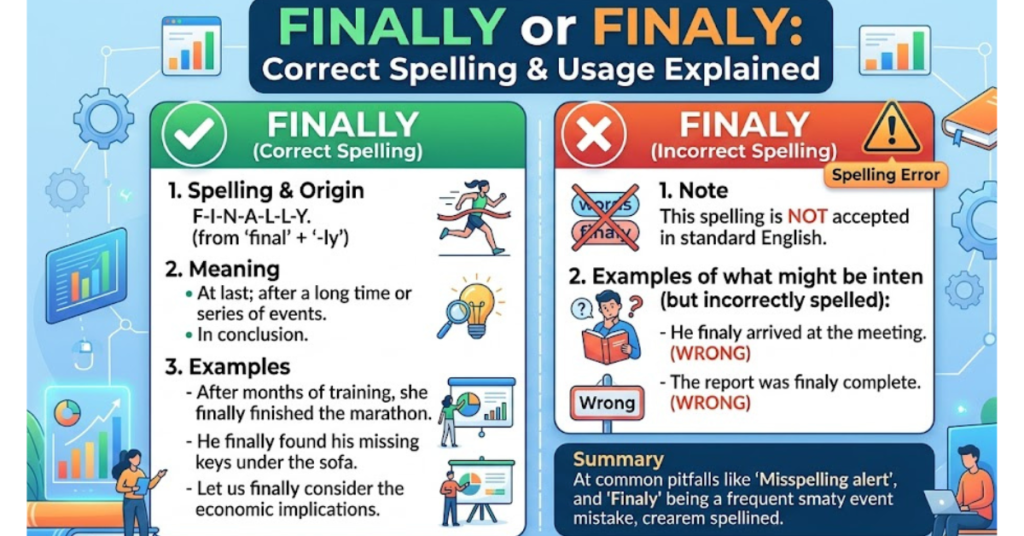
The correct spelling is finally — with an “i” before the “n-a-l-l-y.” The word finaly is simply a misspelling, even though it often appears in informal writing or fast typing.
In this article, we’ll break down the meaning, correct usage, and memory tricks so you never confuse finally or finaly again.
What Does “Finally” Mean?
The word finally is an adverb used to show:
- The end of a long wait
- The last step in a sequence
- A concluding point in speech or writing
Examples:
- I finally finished my homework.
- She finally arrived after two hours.
- We finally agreed on a solution.
In all these cases, finally expresses relief, completion, or conclusion.
Finally or Finaly: Which One Is Correct?
Let’s make it clear:
- Finaly → Incorrect spelling
- Finally → Correct spelling
The confusion usually comes from fast typing or pronunciation, where the double “l” and “y” sound blends together.
Why “Finaly” is Wrong
English words often follow consistent spelling patterns. In this case, “final” becomes “finally” by adding:
- “-ly” (common adverb suffix)
- And doubling the “l” to maintain pronunciation flow
So the correct transformation is:
final → finally, not finaly
Common Mistakes with “Finally or Finaly”
People often misuse the word in informal writing. Here are some typical errors:
1. Typing Error
- “Finaly I understand it”
- “Finally I understand it”
2. Autocorrect Misses
Some devices may not always correct it, especially in usernames or slang text.
3. Speech-to-Text Errors
Voice typing sometimes drops letters, leading to “finaly.”
How to Remember the Correct Spelling
If you struggle with finally or finaly, use these easy tricks:
Trick 1: Think of “final + ly”
Break it down:
- final + ly = finally
Trick 2: Double “L” Reminder
Remember:
Finally has a “long wait” → double L
Trick 3: Say It Slowly
When you pronounce it carefully, you naturally hear the extra “l” sound.
When to Use “Finally” in Writing
“Finally” can be used in different contexts:
1. To Show Conclusion
- Finally, we reached the destination.
2. To Express Relief
- I finally passed the exam!
3. To Sequence Events
- First we planned, then we prepared, and finally we executed.
Synonyms of “Finally” LSI Keywords
Using variations can improve your writing and SEO relevance:
- At last
- Eventually
- In conclusion
- In the end
- After a long time
- Ultimately
These help avoid repetition while keeping meaning intact.
Why Correct Spelling Matters
Even small spelling errors like finaly or finally can:
- Reduce writing credibility
- Affect academic scores
- Hurt SEO rankings in content writing
- Create confusion for readers
In professional or online writing, accuracy builds trust.
FAQs About Finally or Finaly
1. Is “finaly” a correct word?
No, finaly is incorrect. The correct spelling is finally.
2. Why do people write “finaly”?
It usually happens due to fast typing, spelling mistakes, or autocorrect errors.
3. What is the meaning of finally?
It means “at last,” “in the end,” or “after a long time.”
4. How do I avoid spelling mistakes like this?
Practice, use spell-check tools, and remember word patterns like “final + ly.”
5. Is “finally” formal or informal?
It can be used in both formal and informal writing depending on context.
Conclusion
Understanding the difference between finally or finaly is simple once you break it down. The correct form is always finally, used to show completion, relief, or conclusion.
By remembering the root word final and adding the proper suffix -ly, you can avoid this common mistake forever.
If you’re improving your writing skills, paying attention to small details like this makes a big difference in clarity, professionalism, and SEO performance.