
Ever paused mid-sentence wondering whether it’s cancellation vs cancelation? You’re not alone. This is one of those English spelling debates that quietly confuses writers, students, and even professionals.
The keyword cancellation vs cancelation comes up often because both versions look right at first glance—but only one is widely accepted in standard English. In this guide, we’ll break down the difference, explain why it exists, and show you how to use the correct spelling confidently.
What Does “Cancellation” Mean?
Before diving into spelling differences, it helps to understand the word itself.
Cancellation refers to:
- The act of stopping something that was planned
- Ending an appointment, event, subscription, or agreement
- Making something no longer valid
Examples:
- The cancellation of the flight caused delays.
- She received a cancellation notice for her order.
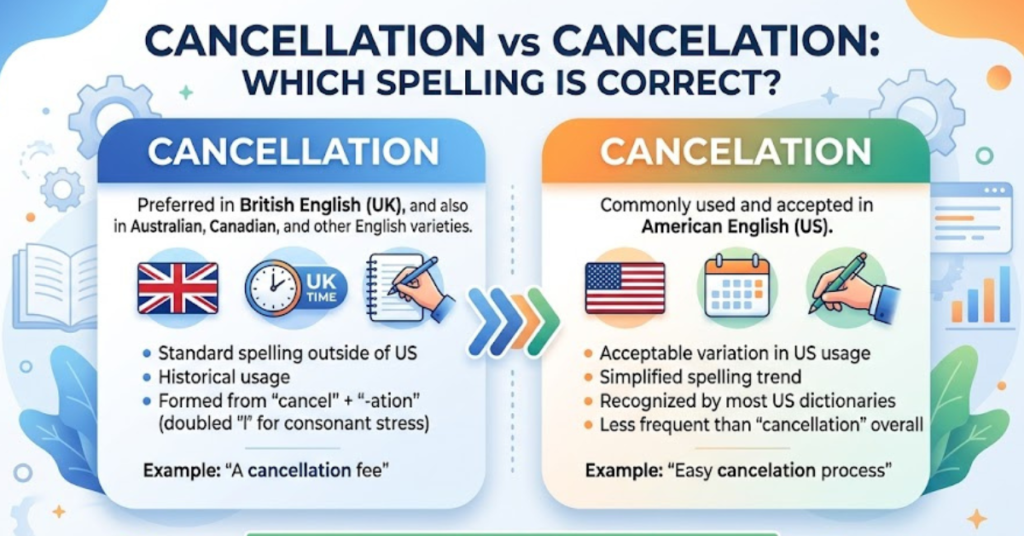
Cancellation vs Cancelation: Which Spelling Is Correct?
Here’s the short answer:
“Cancellation” is the correct and standard spelling in most English varieties.
“Cancelation” is a less common variant, mostly seen in American English usage but widely considered nonstandard.
Why the confusion exists
The confusion between cancellation vs cancelation comes from spelling rules in English where suffixes like -ation are added to verbs.
- Cancel → Cancellation (correct form)
- Cancel → Cancelation (simplified but rarely accepted)
English often doubles consonants when forming nouns:
- Cancel → Cancellation
- Appal → Appallation (historical form, though less common now)
This doubling of the “L” is what makes cancellation the preferred spelling.
British vs American English: Does It Matter?
Yes—and this is where things get interesting.
British English
- Always uses cancellation
- Considered the standard form in formal writing
American English
- Also prefers cancellation
- “Cancelation” appears occasionally but is not widely accepted in dictionaries or professional writing
Key takeaway:
Even in American English, cancellation is the correct and dominant spelling.
Grammar Rule Behind “Cancellation”
To understand cancellation vs cancelation, we need a quick grammar insight.
When forming nouns from verbs ending in a consonant + vowel + consonant pattern (like cancel), English often:
- Doubles the final consonant
- Then adds -ation
Pattern:
Verb → Noun
- cancel → cancellation
- travel → travel(l)ation (historical variation, but “travel” doesn’t double in modern usage)
This rule helps maintain pronunciation consistency and readability.
Common Mistakes with Cancellation vs Cancelation
People often get tripped up in everyday writing. Here are frequent errors:
Incorrect usage:
- I need to request a cancelation of my subscription.
- Flight cancelation happened due to weather.
Correct usage:
- I need to request a cancellation of my subscription.
- Flight cancellation happened due to weather.
Why “Cancelation” Still Appears Online
Even though it’s not standard, you may still see cancelation in:
- Informal writing
- Social media posts
- Older online content
- Occasional American publications
However, most reputable dictionaries and style guides recommend sticking with cancellation for accuracy and professionalism.
Quick Comparison Table
| Feature | Cancellation | Cancelation |
| Standard spelling | Yes | No |
| Dictionary acceptance | Widely accepted | Rare |
| Formal writing | Preferred | Not recommended |
| Usage frequency | High | Very low |
FAQs About Cancellation vs Cancelation
1. Is “cancelation” ever correct?
It exists as a variant spelling, but it is not widely accepted in modern English writing.
2. Why does “cancellation” have two L’s?
English often doubles consonants before adding suffixes like -ation to maintain pronunciation rules.
3. Which spelling should I use in SEO content?
Always use cancellation, as it is the dominant and search-preferred spelling.
4. Do British and American English differ here?
No significant difference—both primarily use cancellation.
5. Can using “cancelation” affect my writing quality?
Yes, it can make your writing look incorrect or less professional in formal contexts.
Conclusion: Cancellation vs Cancelation Explained
The debate around cancellation vs cancelation is simpler than it looks. While both versions appear in writing, cancellation is the correct, standard, and widely accepted spelling across English dialects.
If you want your writing to be accurate, professional, and SEO-friendly, stick with cancellation every time. It’s the version recognized by dictionaries, style guides, and search engines alike.
Understanding small differences like this helps improve not just your grammar, but also the clarity and credibility of your content.
If you found this helpful, exploring other common spelling differences in English can further sharpen your writing skills.