
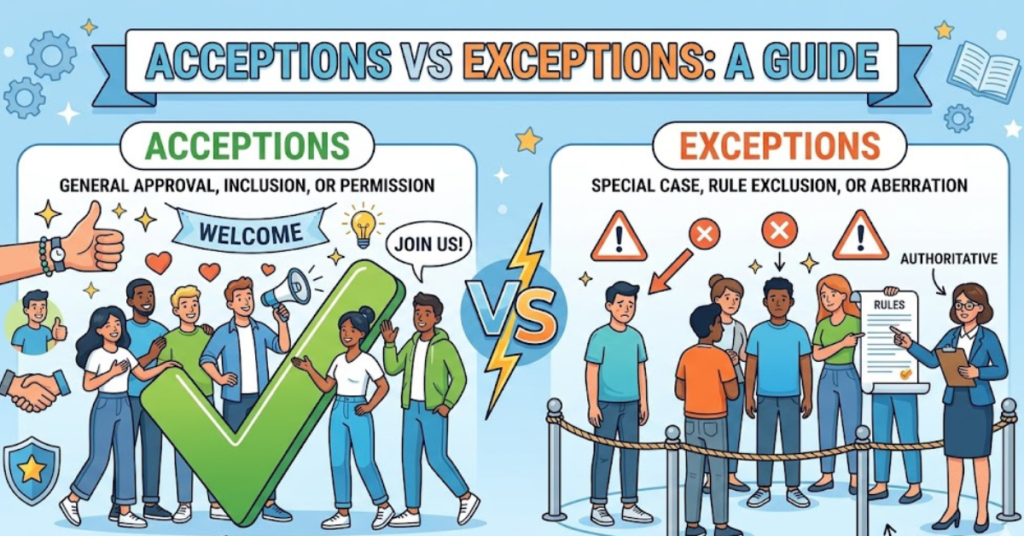

It’s easy to mix up similar-looking words, especially when they sound alike. The confusion around acceptions vs exceptions is a perfect example. At first glance, they seem interchangeable—but in reality, they have very different meanings and uses.
In this guide, we’ll break down what each word means, when to use them, and how to avoid common mistakes. By the end, you’ll feel confident using both correctly in everyday writing and conversation.
What Does “Exceptions” Mean?
Let’s start with the more common word.
Exception refers to something that does not follow a general rule or pattern. It’s used when there’s a case that stands apart from the rest.
Common Uses of “Exception”
- A rule that doesn’t apply in certain situations
- Someone or something excluded from a group
- A special case that differs from the norm
Examples
- Everyone passed the test, with one exception.
- I eat vegetables every day, with the exception of Sundays.
- The policy applies to all employees without exception.
“Exception” is widely used in both formal and informal English.
What Does “Acceptions” Mean?
Now for the less familiar term.
Acceptions is a real word, but it’s rarely used in modern English. It refers to different meanings or interpretations of a word, especially in linguistic or academic contexts.
Where You Might See “Acceptions”
- In dictionaries or language studies
- When discussing multiple meanings of a term
- In older or highly formal texts
Examples
- The word has several acceptions depending on context.
- Scholars debated the various acceptions of the term.
In everyday conversation, most people use “meanings” instead of “acceptions.”
Acceptions vs Exceptions: Key Differences
Understanding the difference is simpler than it looks.
1. Meaning
- Exception: Something excluded from a rule
- Acceptions: Different meanings of a word
2. Usage Frequency
- Exception: Very common in daily language
- Acceptions: Rare and mostly academic
3. Context
- Exception: Used in general communication
- Acceptions: Used in linguistic or scholarly discussions
Why People Confuse Acceptions vs Exceptions
There are a few reasons this mix-up happens:
- They look and sound similar
- Both relate to variation or difference
- “Acceptions” is unfamiliar, so people assume it’s a misspelling
In reality, “exception” is what most people mean in everyday situations.
How to Use Exceptions Correctly
If you’re writing or speaking in general contexts, “exception” is likely the word you need.
Quick Tips
- Use it when talking about rules and exclusions
- Pair it with phrases like “with the exception of”
- Remember it’s the standard choice in modern English
How to Use Acceptions Correctly
Use “acceptions” only in specific contexts.
Best Situations
- Academic writing
- Language analysis
- Discussions about word meanings
If you’re unsure, it’s usually safer to say “meanings” instead.
Easy Trick to Remember the Difference
Here’s a simple way to keep them straight:
- Exception = Excluded from a rule
- Acceptions = Accepted meanings of a word
The word “accept” can help you remember that “acceptions” relates to meanings that are accepted in language.
Common Mistakes to Avoid
Even experienced writers slip up sometimes.
- Using “acceptions” when you mean “exceptions”
- Assuming “acceptions” is just a spelling error
- Overusing rare terms in everyday writing
Stick with clarity, especially in casual or professional communication.
FAQs
Is “acceptions” a real word?
Yes, but it’s rare and mainly used in academic or linguistic contexts.
Which is more common: acceptions or exceptions?
“Exceptions” is far more common and widely used in everyday English.
Can I use “acceptions” instead of “exceptions”?
No, they have different meanings and are not interchangeable.
What is the easiest way to remember the difference?
Think of “exception” as something excluded, and “acceptions” as accepted meanings.
Why do people confuse acceptions vs exceptions?
Because they look and sound similar, and “acceptions” is not commonly used.
Conclusion
Understanding acceptions vs exceptions comes down to recognizing their roles in language. “Exception” is the word you’ll use most often, especially when talking about rules and exclusions. “Acceptions,” on the other hand, belongs to a more specialized, academic setting.
If you want your writing to be clear and effective, stick with “exception” in everyday use. And when discussing language itself, you’ll know exactly when “acceptions” fits.