
At first glance, dysregulation vs disregulation might seem like just another confusing spelling dilemma—but the truth is, only one of these terms is actually correct. If you’ve ever paused mid-sentence wondering which version to use, you’re not alone. This article breaks down the real meaning, correct usage, and common mistakes surrounding these words, so you can write with confidence and clarity.
Dysregulation vs Disregulation: What’s the Difference?
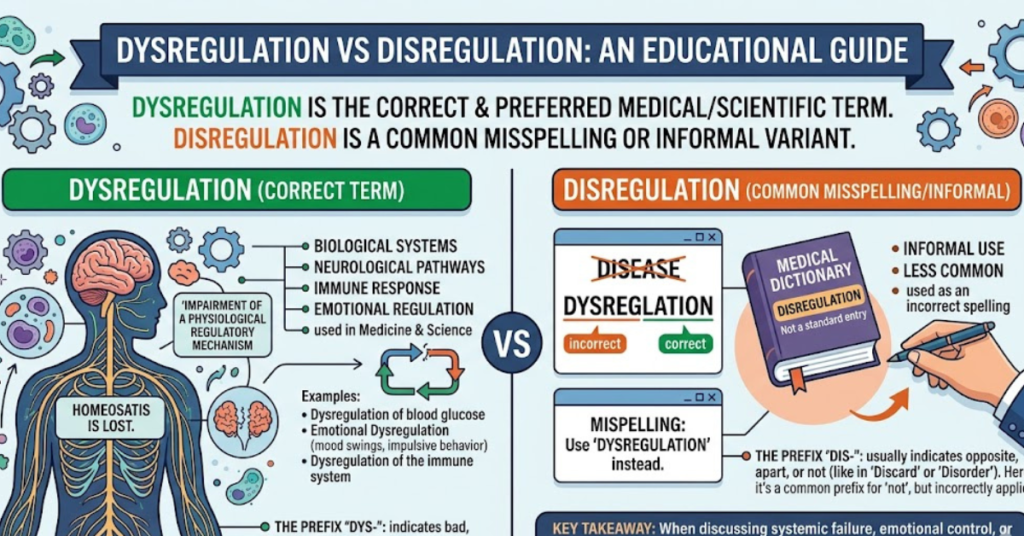
Let’s clear this up right away:
- Dysregulation is a real word with a specific meaning.
- Disregulation is generally considered a misspelling or incorrect form.
Understanding this distinction is essential, especially in academic, medical, or psychological contexts where precision matters.
What Does Dysregulation Mean?
Definition and Usage
Dysregulation refers to an inability to manage or control processes effectively. It’s commonly used in fields like psychology, biology, and medicine.
For example:
- Emotional dysregulation occurs when someone struggles to manage their emotions.
- Hormonal dysregulation can lead to imbalances in the body.
Common Contexts
You’ll often see this term used in:
- Mental health discussions (e.g., anxiety, ADHD, PTSD)
- Biological systems (e.g., immune or endocrine system)
- Behavioral studies
Simple Examples
- “The child showed signs of emotional dysregulation.”
- “Sleep dysregulation can affect overall health.”
Is Disregulation a Real Word?
Why It’s Incorrect
Disregulation is not recognized as a standard English word in most dictionaries. It appears to be a mistaken variation of “dysregulation,” likely caused by confusion with words that start with “dis-” (like disconnect or disorder).
Common Misunderstandings
People often assume:
- “Dis-” means “not,” so “disregulation” might mean lack of regulation.
However, English doesn’t follow that pattern here. The correct prefix is “dys-,” which specifically implies abnormal or impaired functioning.
Breaking Down the Prefixes: Dys- vs Dis-
Understanding prefixes helps avoid confusion.
Dys- (Correct Usage)
- Means: abnormal, impaired, or difficult
- Examples:
- Dysfunction
- Dyslexia
- Dysregulation
Dis- (Different Meaning)
- Means: not, opposite of, or removal
- Examples:
- Disagree
- Disconnect
- Disapprove
The key takeaway: Dysregulation uses the correct prefix for its meaning, while “disregulation” does not.
Why Dysregulation Matters in Real Life
The concept of dysregulation goes beyond vocabulary—it plays a significant role in understanding human behavior and health.
Areas Where It’s Important
- Mental Health
- Emotional dysregulation is linked to mood disorders.
- Physical Health
- Dysregulation of hormones can lead to conditions like diabetes.
- Daily Life
- Difficulty managing stress or reactions often points to regulation issues.
Recognizing the term helps you better understand these challenges and communicate them accurately.
Tips to Remember the Correct Term
To avoid mixing up dysregulation vs disregulation, keep these simple tips in mind:
- Think of “dys-” as “difficulty” or “dysfunction.”
- Associate it with medical or psychological contexts.
- If “disregulation” looks right, double-check—it’s almost always incorrect.
Common Mistakes to Avoid
Here are a few pitfalls people often fall into:
- Using “disregulation” in formal writing
- Assuming both terms are interchangeable
- Misunderstanding the meaning of prefixes
Stick with dysregulation to stay accurate and credible.
FAQs
1. What is the correct spelling: dysregulation or disregulation?
The correct spelling is dysregulation. “Disregulation” is not standard English.
2. What does dysregulation mean in simple terms?
It means difficulty in controlling or managing something, especially emotions or biological processes.
3. Is disregulation ever acceptable?
No, it’s generally considered a misspelling and should be avoided in both formal and informal writing.
4. Where is dysregulation commonly used?
It’s widely used in psychology, medicine, and biology to describe impaired regulation.
5. Why do people confuse dysregulation with disregulation?
The confusion comes from the common “dis-” prefix in English, leading people to assume it fits here as well.
Conclusion
When it comes to dysregulation vs disregulation, the answer is straightforward: only dysregulation is correct. It’s a meaningful term used across multiple disciplines to describe impaired control or imbalance. On the other hand, “disregulation” is simply a common error that can undermine your credibility if used incorrectly.
Mastering small distinctions like this can make a big difference in your writing. If you found this helpful, consider exploring other commonly confused words to sharpen your language skills even further.