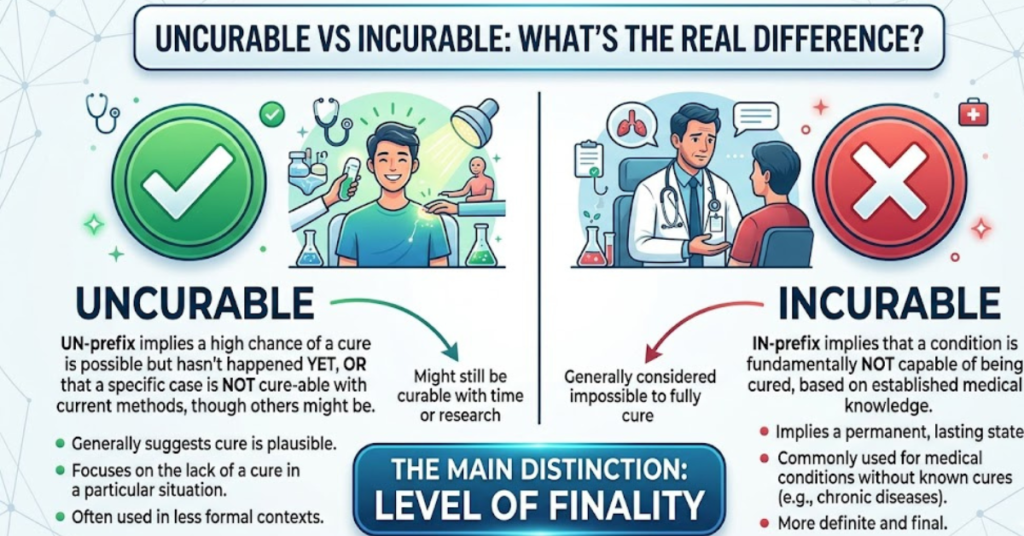

Have you ever paused mid-sentence wondering whether to say uncurable or incurable? You’re not alone. The phrase uncurable vs incurable confuses even fluent English speakers, especially because both words seem to mean the same thing at first glance.
In this article, we’ll break down the subtle (and not-so-subtle) differences between the two, explore how they’re used in real life, especially in medical and emotional contexts—and help you choose the right word with confidence.
What Does “Incurable” Mean?
Incurable is the more widely accepted and commonly used term. It refers to something—usually a disease or condition—that cannot currently be cured.
Key characteristics:
- Common in medical and scientific contexts
- Recognized as standard English usage
- Often used in serious or formal discussions
Examples:
- “The disease is considered incurable but manageable.”
- “He suffers from an incurable illness.”
In simple terms, incurable means there is no known cure available—at least for now.
What Does “Uncurable” Mean?
Uncurable technically carries the same meaning: something that cannot be cured. However, it’s far less commonly used and often considered nonstandard or awkward.
Key characteristics:
- Rarely used in modern English
- Sometimes seen as incorrect or informal
- May appear in older texts or casual speech
Examples:
- “Some habits seem uncurable.”
- “He believed the condition was uncurable.”
While not strictly wrong, uncurable can sound unnatural to native speakers.
Uncurable vs Incurable: The Key Differences
Let’s break it down clearly.
1. Usage Frequency
- Incurable → widely used and accepted
- Uncurable → rarely used
2. Context
- Incurable → preferred in medical, academic, and formal writing
- Uncurable → occasionally used in informal or stylistic contexts
3. Perception
- Incurable → sounds professional and precise
- Uncurable → may sound incorrect or outdated
Why “Incurable” Is Preferred
English often favors certain prefixes over others, even when both are technically correct. The prefix “in-” is commonly used to negate adjectives (like incomplete, inaccurate), which makes incurable feel more natural.
On the other hand, “un-” is also a negation prefix, but it doesn’t pair as smoothly with certain words—curable being one of them.
Real-World Contexts Where the Difference Matters
Medical Field
Doctors, researchers, and healthcare professionals almost always use incurable. It conveys clarity and avoids confusion.
Everyday Conversations
In casual speech, people may use either word, but incurable still sounds more natural and widely understood.
Emotional or Figurative Use
Both words can describe abstract things, like habits or traits:
- “He’s an incurable optimist.”
- “She’s an incurable romantic.”
In these cases, incurable again dominates.
Common Mistakes to Avoid
When discussing uncurable vs incurable, here are a few pitfalls to watch out for:
- Using uncurable in formal writing
- Assuming both words are equally accepted
- Overthinking when incurable is almost always the safer choice
Quick Comparison Table
| Feature | Incurable | Uncurable |
| Usage | Very common | Rare |
| Formality | Formal/standard | Informal/nonstandard |
| Acceptance | Widely accepted | Limited |
| Best choice? | Yes | Usually no |
When (If Ever) Should You Use “Uncurable”?
There are a few niche situations where uncurable might appear:
- Creative writing for stylistic effect
- Dialogue to reflect informal speech
- Historical or archaic texts
Even then, it’s often better to stick with incurable unless you have a specific reason.
FAQs
Is “uncurable” a real word?
Yes, uncurable exists, but it’s rarely used and often considered nonstandard in modern English.
Which is correct: uncurable or incurable?
Incurable is the correct and preferred term in most contexts.
Can I use “uncurable” in formal writing?
It’s not recommended. Use incurable to maintain clarity and professionalism.
Do both words mean the same thing?
Yes, both mean “not able to be cured,” but their usage differs significantly.
Why does “incurable” sound more natural?
Because the prefix “in-” is more commonly used with words like curable, making it sound more familiar and correct.
Conclusion
When it comes to uncurable vs incurable, the difference isn’t about meaning—it’s about usage and acceptance. While both words technically say the same thing, incurable is the clear winner in modern English. It’s more natural, widely recognized, and appropriate for nearly every situation.
If you want to sound confident and precise, stick with incurable. And if you’re ever unsure, remember this simple rule: when in doubt, go with what people actually use.