
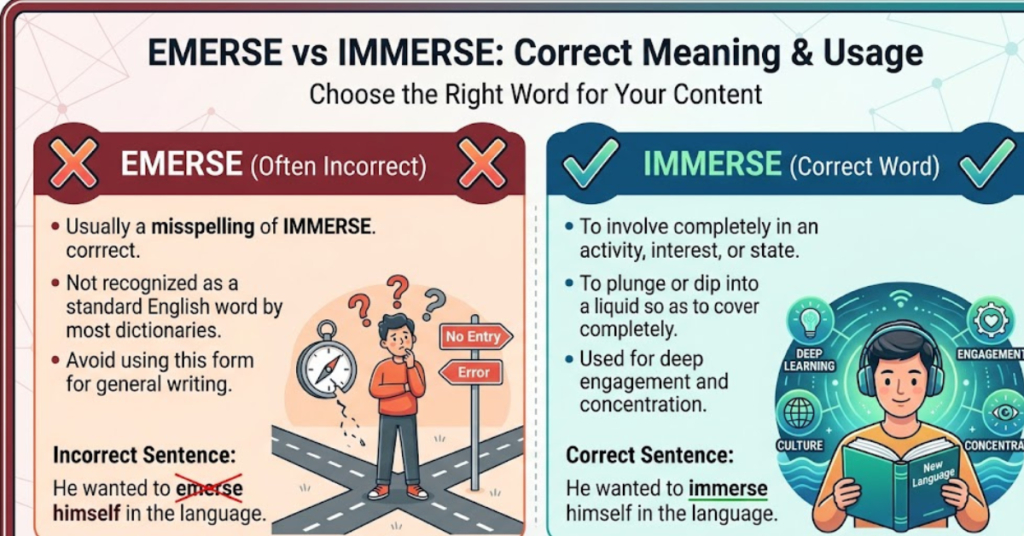

Have you ever typed emerse and wondered why it doesn’t feel quite right? You’re not alone. The confusion around emerse vs immerse is surprisingly common, especially since both words seem like they should exist.
Here’s the quick truth: one is correct and widely used, while the other is mostly a mistake. In this guide, we’ll break down the difference, explain the real meaning, and show you how to use the correct word confidently in everyday writing.
Emerse vs Immerse: What’s the Difference?
Let’s clear this up immediately:
- Immerse → Correct and widely used
- Emerse → Incorrect or extremely rare/misspelled form
If you’re choosing between emerse vs immerse, the correct word you’re looking for is almost always immerse.
What Does “Immerse” Mean?
The word immerse means to dip something completely into a liquid or to become deeply involved in something.
Common Meanings
- Literal meaning: To submerge something in water
- Figurative meaning: To fully engage or absorb yourself in an activity
Example Sentences
- She decided to immerse herself in learning a new language.
- The cloth was immersed in warm water.
- He became fully immersed in his work project.
In everyday usage, the figurative meaning is far more common.
Is “Emerse” a Real Word?
Technically, emerse exists in very limited scientific contexts, particularly in biology, where it refers to something rising out of water. However, this usage is rare and not part of everyday English.
In most cases, when people write emerse, they actually mean immerse. That’s why in the debate of emerse vs immerse, emerse is generally treated as a misspelling.
Why People Confuse Emerse and Immerse
This mix-up happens more often than you’d think. Here’s why:
1. Similar Sound
Both words sound alike, especially in fast speech.
2. Prefix Confusion
English has many prefixes like “em-” and “im-,” which can make spelling tricky.
3. Typing Habits
Quick typing or autocorrect mistakes often lead to emerse instead of immerse.
How to Remember the Correct Word
If you’re stuck choosing between emerse vs immerse, try these memory tricks:
- Think “in” → immerse
“Im” sounds like “in,” helping you remember it means going into something. - Picture water
Imagine immersing yourself in a pool—completely surrounded. - Double ‘m’ rule
Immerse has two “m” letters, which helps lock in the correct spelling.
Common Uses of “Immerse” in Daily Life
You’ll see immerse used in many contexts:
Learning and Education
- Immersing yourself in a new subject
- Language immersion programs
Work and Productivity
- Deep focus on tasks
- Getting fully involved in projects
Entertainment
- Immersing yourself in a movie or book
- Experiencing virtual reality environments
It’s a versatile word that fits both formal and casual communication.
Similar Words and Alternatives
To expand your vocabulary, here are some alternatives to immerse:
- Engage
- Absorb
- Submerge
- Involve
- Dive into
Each carries a slightly different tone, but all relate to deep involvement.
FAQs
Emerse vs immerse—which is correct?
Immerse is the correct and commonly used word. Emerse is rarely used and often a mistake.
What does immerse mean?
It means to fully involve yourself in something or to submerge something in liquid.
Is emerse ever correct?
It can appear in scientific contexts, but it’s not used in everyday language.
Why do people write emerse instead of immerse?
Mostly due to pronunciation confusion or typing errors.
How can I remember the correct spelling?
Think of “immerse” as going in—the “im” helps you remember.
Conclusion
When it comes to emerse vs immerse, the choice is simple: immerse is the correct word for almost every situation. While emerse may exist in rare technical contexts, it’s not something you’ll need in everyday writing.
Mastering small distinctions like this can make your communication clearer and more professional. So next time you’re writing, go ahead and immerse yourself in confidence—you’ve got it right.